The Interview Readiness Gap: A Simple Framework for TPOs
Why most placement preparation programs fail—and how to fix them. A data-driven framework showing why students who complete 10+ mock interviews are 3x more likely to succeed, and how TPOs can audit and close the Practice + Feedback gap at scale.

Lawrence Paranidharan
Founder & CEO

After analyzing placement outcomes across institutions and talking to TPOs navigating the 2026 season, I've noticed a pattern.
The problem isn't awareness. Students know interviews are coming. They attend PPTs. They understand the process.
The problem isn't motivation. Final-year students are anxious, eager, and willing to prepare.
The problem is structural. Most preparation systems skip the most important layer.
The Three Stages of Interview Readiness
Here's a simple way to think about what it takes to become interview-ready:
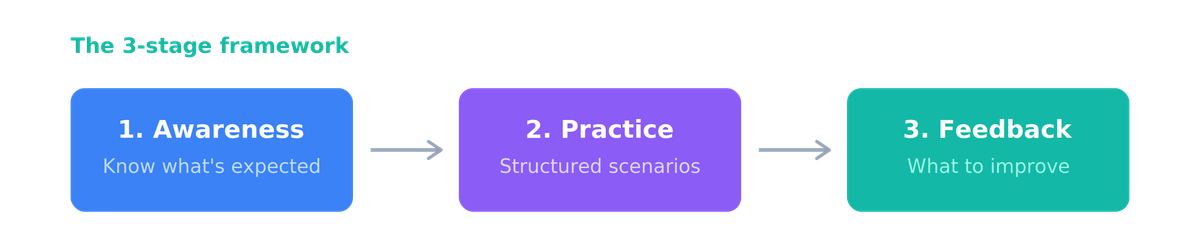
Stage 1: Awareness — Understanding what is expected in real interviews. Knowing the format, the question types, the company expectations.
Stage 2: Practice — Repeated exposure to structured scenarios. Speaking answers out loud, handling pressure, building muscle memory.
Stage 3: Feedback — Knowing what to improve and how. Specific, actionable insights that can be applied in the next practice session.
That's it. Three stages. But here's what actually happens at most institutions:
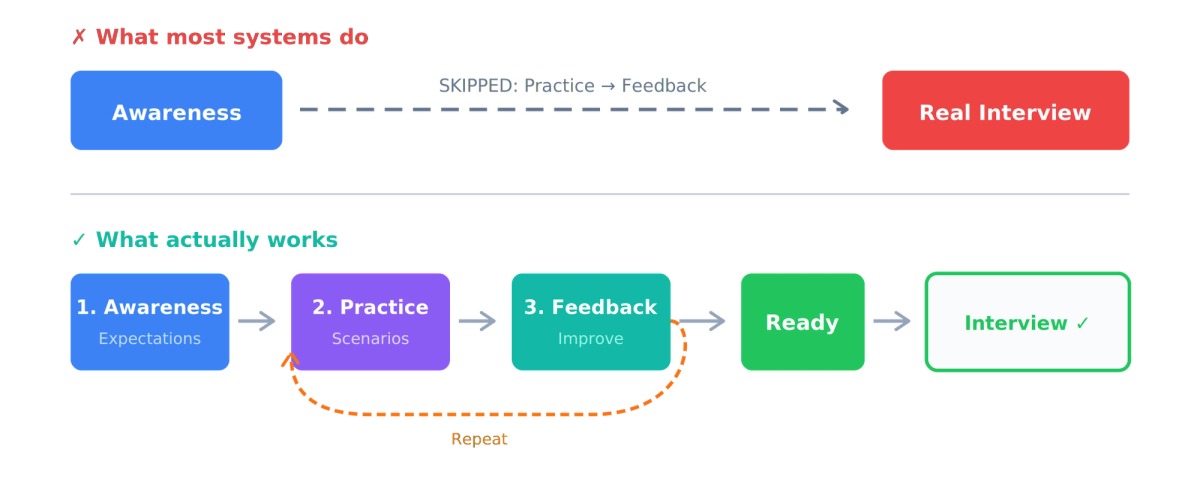
The Broken Flow: What Most Systems Actually Do

Students learn what interviews look like. Then they walk into one. The missing layer is structured Practice + Feedback at scale. That's where the gap is.
Stage 1: Awareness ✓ (Most Institutions Do This Well)
What it covers: Understanding selection rounds (aptitude, technical, HR, GD), knowing what companies look for, familiarity with common question types, resume expectations and formats, dress code and body language basics.
How institutions typically deliver this: Pre-placement talks (PPTs), orientation sessions, placement brochures and handbooks, senior student sharing sessions, YouTube videos and online content.
The reality: Most institutions do this reasonably well. Students are not unaware. They know interviews exist. They know what's expected in theory.
"Audit question for TPOs: Do your students understand what a real interview looks like? If yes → Stage 1 is covered. ✓"
Stage 2: Practice ✗ (Where Most Programs Fail)
What it covers: Repeated exposure to interview scenarios, speaking answers out loud (not just thinking them), handling pressure and time constraints, practicing across different question types, building muscle memory for common situations.
How institutions typically deliver this: 1-2 mock interviews per student (if any), group mock sessions (limited individual time), peer practice (unstructured), "practice on your own."
The reality: This is where most programs fail. A placement cell with 2,000 students and 5 staff members cannot provide meaningful individual practice. The math doesn't work.
The Scale Problem: Why Traditional Mock Interviews Don't Scale
| Metric | Calculation | Result |
|---|---|---|
| One mock per student | 2,000 students × 30 min | 1,000 hours |
| Recommended mocks | 10+ per student | 10,000 hours needed |
| Success correlation | 10+ mocks completed | 3x higher success rate |
| Actual mocks completed | Most students | 0-2 before first interview |
"Audit question for TPOs: How many structured mock interviews does your average student complete before their first campus drive? If the answer is less than 5 → Stage 2 is the gap. ✗"
Stage 3: Feedback ✗ (The Missing Intelligence Layer)
What it covers: Specific, actionable improvement areas, understanding what went wrong and why, clarity on what "good" looks like, progress tracking over time, confidence calibration (knowing where you actually stand).
How institutions typically deliver this: Generic advice after group sessions, "You need to be more confident," "Work on your communication," no structured tracking.
The reality: Even when practice happens, feedback is usually too generic ("Improve your confidence"), too late (after the real interview), too infrequent (one data point isn't feedback), and not actionable (what specifically should change?).
Students don't know where they stand. They can't see their progress. They walk into interviews hoping they're ready, not knowing they're ready.
"Audit question for TPOs: Can your students tell you specifically what they need to improve and track their progress over time? If no → Stage 3 is the gap. ✗"
The Missing Infrastructure: The Practice ↔ Feedback Loop
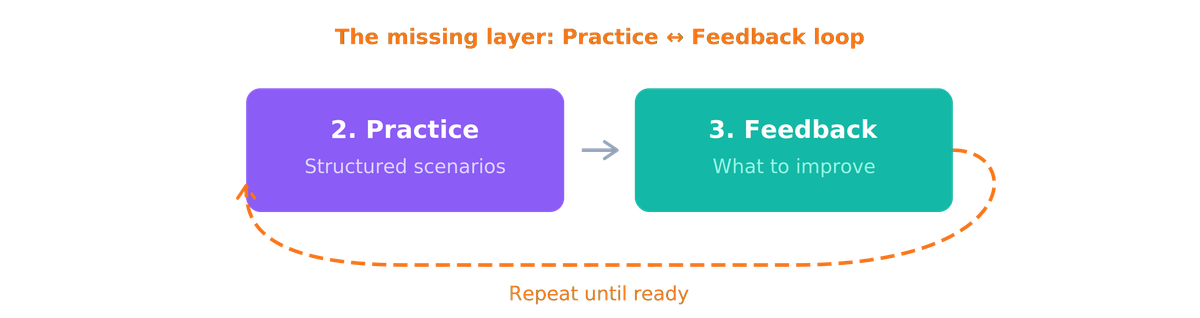
Interview readiness isn't a linear journey. It's a loop. Practice reveals gaps. Feedback identifies them. More practice closes them. This cycle repeats until the student is genuinely ready. The Practice ↔ Feedback loop is the missing infrastructure.
What a Complete System Looks Like
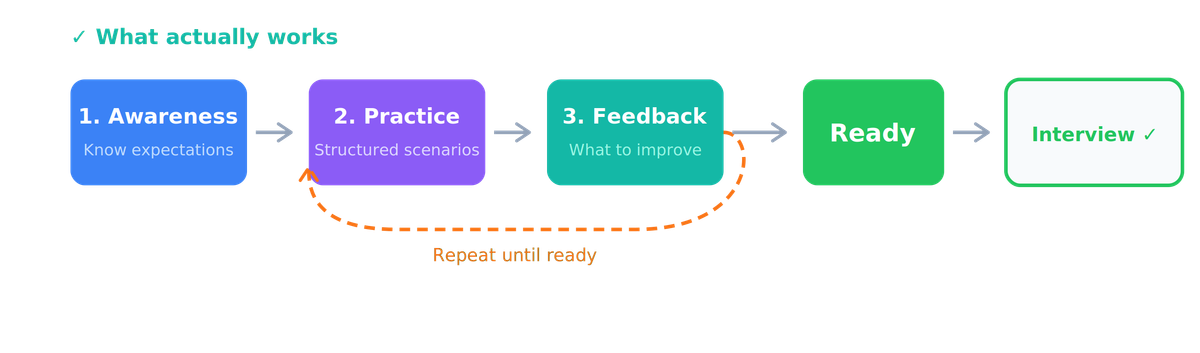
A complete system moves students through all three stages, with enough cycles of Practice + Feedback to build genuine readiness. The "Ready" state isn't a hope—it's a measurable outcome based on demonstrated improvement over multiple practice sessions.
The Gap Visualized: Broken vs. Working Systems
Why This Gap Exists (It's Not the TPO's Fault)
I want to be clear: this isn't about effort or intention. TPOs work incredibly hard. Placement cells are understaffed and overworked. The challenge is structural, not motivational.
The Structural Challenges
The scale problem: India produces 15+ lakh engineering graduates annually across 8,200+ technical institutions. Average placement cell: 3-5 staff for 1,000-2,000+ students.
The math problem: 10 mocks per student × 2,000 students = 20,000 mock sessions. At 30 min each = 10,000 hours of staff time. That's 5 full-time employees doing nothing but mocks for an entire year.
The timing problem: Placement season is compressed. Companies visit in waves. There's no time to iterate once drives begin.
Traditional methods cannot solve this at scale. That's not an opinion—it's arithmetic.
What TPOs Can Do Today
Even without new technology, here's how to apply this framework:
1. Audit Your Current Program
Map your existing activities to the three stages. Ask yourself: How much time is spent on Stage 2 and Stage 3 vs. Stage 1? Most programs are 80% Awareness, 20% Practice, ~0% structured Feedback.
Activity-to-Stage Mapping for Placement Programs
| Activity | Stage Covered |
|---|---|
| PPTs, orientation sessions | Awareness |
| Group mock sessions | Practice (limited) |
| Aptitude training | Awareness + Practice |
| Resume workshops | Awareness |
| Soft skills sessions | Awareness |
| 1-on-1 mock interviews | Practice + Feedback |
| Peer practice | Practice (unstructured) |
2. Quantify the Practice Gap
Calculate your current state: Total students eligible for placement, number of structured mock interviews conducted last year, mocks per student. Target (research-backed): 10+ mocks per student. This gives you a number. Numbers are actionable.
3. Explore Scalable Solutions
Options to Scale Practice + Feedback
- •Peer mock programs (structured): Train student volunteers as mock interviewers. Provide rubrics and feedback templates. Requires coordination but multiplies capacity.
- •Alumni mock programs: Recent alumni conduct virtual mocks. Industry perspective + institutional connection. Requires alumni engagement infrastructure.
- •Industry mock partnerships: Companies conduct practice sessions before actual drives. Mutual benefit—companies see more prepared candidates.
- •AI-powered mock platforms: 24/7 availability, unlimited practice capacity, structured feedback at scale, consistent quality across all students.
Each option has trade-offs. The key is recognizing that Stage 2 and Stage 3 require different solutions than Stage 1. You can't "workshop" your way to interview readiness. Students need reps.
4. Reframe Success Metrics
Most placement cells track outcomes: number of companies visiting, number of offers made, placement percentage, average package. These are important—but they don't tell you where the process broke down.
Input Metrics to Add
- Mock interviews completed per student (before placement season)
- Students who completed 10+ practice sessions
- Average feedback score improvement over time
- Student confidence self-assessment (pre vs. post prep)
What gets measured gets managed. If you measure Stage 2 and Stage 3 activity, you can improve it.
The Bottom Line
Interview readiness isn't magic. It's not about finding the "right" training content or the "best" placement consultant. It's about reps + feedback.
Awareness → Practice → Feedback → Practice → Feedback → Ready
Most systems deliver Awareness well and Real Interviews eventually. The gap is everything in between.
A Simple Diagnostic for TPOs
If you're a TPO reading this, here's a 2-minute diagnostic:
2-Minute Gap Diagnostic
Can your average student articulate what they need to improve before their first interview?
How many structured mock interviews does your average student complete before placement season?
Do students receive specific, actionable feedback they can track over time?
If you answered "no" or "not sure" to any of these → you've identified your gap. The good news: this gap is fixable. It requires infrastructure, not inspiration.
What We're Building at SpectraSeek
This framework—Awareness → Practice → Feedback—is exactly why we built SpectraSeek. We're not trying to replace PPTs or placement cells. Stage 1 (Awareness) is already covered.
We're building the infrastructure for Stage 2 and Stage 3 at scale:
SpectraSeek's Practice + Feedback Infrastructure
- •AI mock interviews available 24/7—unlimited practice capacity
- •Personalized questions based on student CV and target JD
- •Real-time feedback on content, communication, and confidence
- •Progress tracking that students and TPOs can both see
- •Cohort analytics to identify where intervention is needed
The goal isn't to replace human guidance. It's to make the Practice ↔ Feedback loop possible for every student—not just the few who get 1-on-1 time.
Close the Practice + Feedback Gap at Your Institution
SpectraSeek helps TPOs and placement cells deliver structured mock interviews and actionable feedback to every student—at scale. We work alongside your existing programs, not in place of them.
Explore SpectraSeek for Universities →See also
The 2026 Placement Season Is Here. But Are Students Ready? · Master the STAR Method: Your Secret Weapon for Behavioral Interviews | … · How to Make Your Resume ATS-Friendly: A Complete Guide for 2025
Tags
Related Posts
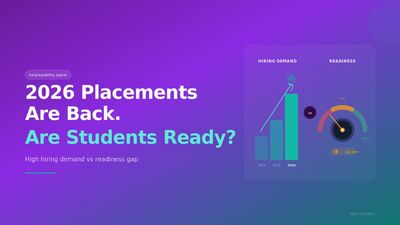
The 2026 Placement Season Is Here. But Are Students Ready?
With only 42.6% of Indian graduates employable and youth unemployment near 40%, the 2026 campus placement season exposes a critical preparation gap. Here's what the data reveals and what students, universities, and placement cells need to know.
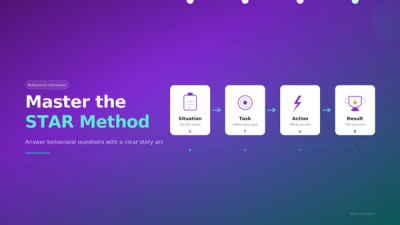
Master the STAR Method: Your Secret Weapon for Behavioral Interviews | SpectraSeek
Learn how to structure your answers using the STAR method and impress interviewers at top companies like Google, Amazon, and TCS. This comprehensive guide includes real examples and practice exercises.
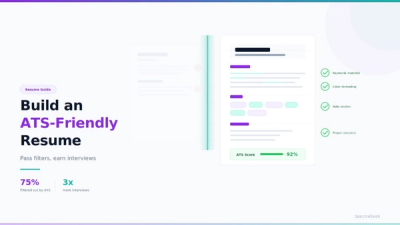
How to Make Your Resume ATS-Friendly: A Complete Guide for 2025
Learn how to optimize your resume for Applicant Tracking Systems. This comprehensive guide covers formatting, keywords, common mistakes, and testing strategies to help you get past the bots and land more interviews.

